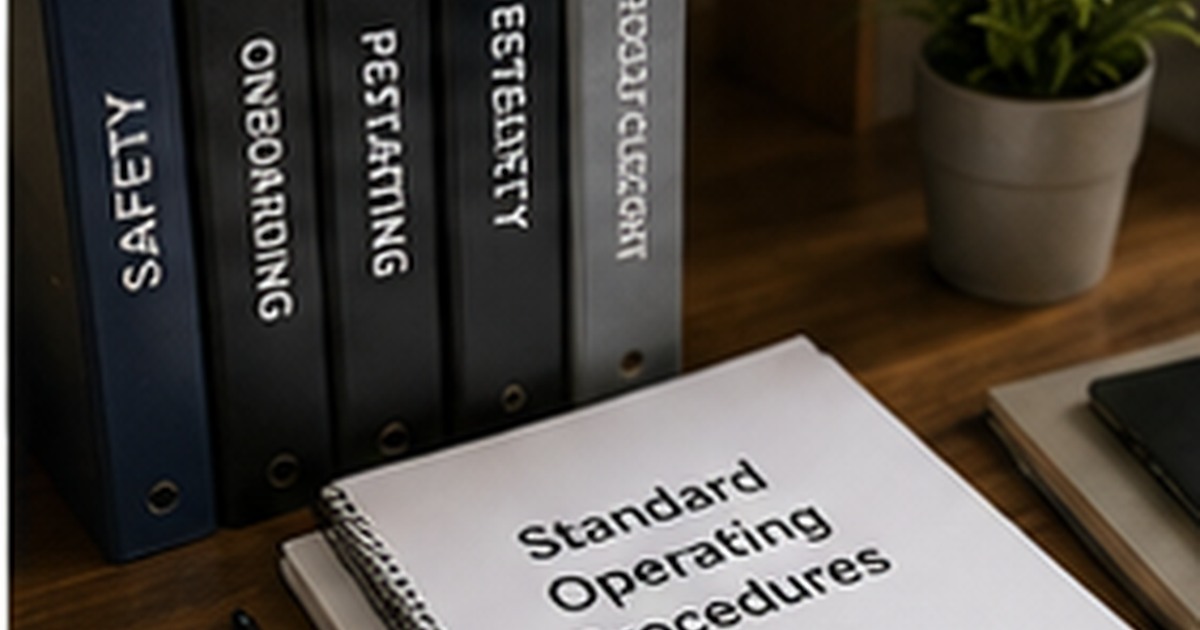
The problem with many SOPs is not that employees refuse to follow instructions. The problem is that the document was written for a binder, an auditor, or the person who already knows the job.
That distinction matters because the wrong diagnosis creates the wrong fix. Small businesses rarely need more corporate process for its own sake. They need enough structure that capable people can move work, see what matters, and handle normal decisions without everything routing back to one person.
TL;DR
- An unused SOP is not a system.
- Write for the person doing the work under real conditions.
- Keep ownership and review dates visible.
What is really happening
For owners building documentation, the visible problem often looks personal: someone is slow, someone forgot, someone did not communicate, or the owner needs to pay closer attention. The operating question is different: what about the current system makes this outcome likely?
Real operations create pressure at the seams—where work changes hands, where a decision is ambiguous, where information is missing, or where an exception does not fit the normal path. Those seams deserve more attention than another broad reminder to “communicate better.”
Signs this is an operating problem
- the SOP is longer than the task requires
- employees cannot find it at the moment they need it
- screenshots and forms are outdated
- the document describes the ideal process but ignores common exceptions
- nobody owns updates when the work changes
One of these signs by itself may be normal. Several of them appearing every week is a pattern. Patterns should be treated as design feedback.
What owners commonly get wrong
The common mistake is documenting from memory or from the ideal process instead of watching the real work. That produces procedures employees technically “have” but do not trust when real conditions get messy.
What to do instead
1. Write for the person doing the work under normal pressure
Write for the person doing the work under normal pressure.
Use real examples from the last two weeks. Abstract discussions make weak processes sound cleaner than they are. A live job, order, customer issue, or employee question will show where the friction actually sits.
2. Put the purpose, trigger, owner, and definition of done near the top
Put the purpose, trigger, owner, and definition of done near the top.
Be specific enough that two competent people would interpret the rule the same way. Words like “soon,” “urgent,” “complete,” and “handle it” are often where ambiguity hides.
3. Use short steps, screenshots, photos, examples, and decision tables where they help
Use short steps, screenshots, photos, examples, and decision tables where they help.
Responsibility without authority creates escalation. Authority without visible limits creates risk. The business needs both the responsibility and the boundary.
4. Document common exceptions and the escalation path
Document common exceptions and the escalation path.
Visibility should reduce the need to ask. A simple reliable queue or board is more useful than a sophisticated dashboard nobody trusts.
5. Store the SOP where the work happens or where employees naturally look
Store the SOP where the work happens or where employees naturally look.
6. Assign an owner and a review trigger instead of relying on annual cleanup
Assign an owner and a review trigger instead of relying on annual cleanup.
7. Update the SOP when training exposes confusion
Update the SOP when training exposes confusion.
What this looks like in the real world
A warehouse receiving SOP should not begin with a page of policy language. It should tell the receiver how to identify the shipment, what to inspect, where to record discrepancies, when to reject material, and who to contact for an exception.
The exact tool is secondary. A whiteboard, spreadsheet, project system, CRM, ERP, form, checklist, or automation can all work when the operating logic is clear. None of them can rescue vague ownership or invisible decisions by themselves.
What good looks like
A healthier operation does not mean nothing ever goes wrong. It means normal work moves without heroics, exceptions become visible early, employees know the limits of their authority, and the owner is involved because a decision truly requires ownership—not because the system ran out of answers.
- Work has a clear owner.
- Status is visible without a scavenger hunt.
- Common decisions have boundaries.
- Exceptions have an escalation path.
- The process can survive a normal absence.
- Improvements reduce work instead of adding administrative theater.
The bottom line
A useful SOP reduces questions, errors, and training time. If nobody uses it, treat that as feedback about the system—not a character flaw in the employee.
If the same operational headache keeps returning, the answer is rarely another motivational speech or another layer of reminders. Start with the workflow, ownership, handoffs, information, and decision rules that keep reproducing the problem.
Orderly Untamed works hands-on with owner-dependent businesses to diagnose those recurring problems, build the missing structure, and make the changes work inside the actual operation.